Tesla FSD v15 has arrived, and it may be the most significant update to Tesla’s driver assistance software in years. On Saturday 21 November 2026, Tesla began rolling out Full Self-Driving version 15 to a first wave of Early Access owners, bringing a new vision system, a striking new visualisation, and a headline safety claim that has already sparked debate. The update, version 15.0.1 on software build 2026.38.6.11, is currently limited to cars with Hardware 4, with a wider release expected in December 2026.
For Tesla owners, FSD updates are always a big event. Each new version promises smoother driving and fewer interventions. Version 15 raises the stakes further, because Tesla says it is built on a fundamentally upgraded vision system, and because the company is making one of its boldest safety claims yet.
Tesla FSD v15: What Is Rolling Out and Who Gets It First
The rollout began on 21 November 2026 with a first wave of Early Access owners, Tesla customers who opted into the company’s early software testing programme and typically receive new features before the wider fleet. The initial release is version 15.0.1, running on software 2026.38.6.11.
Crucially, Tesla FSD v15 is available only on Hardware 4, also known as AI4, cars. Owners of older Hardware 3 vehicles are not included in this first wave, and Tesla has not said when, or whether, they will receive the update.
A wider release is expected in December 2026, according to Elon Musk, who said on X that the broader rollout would come with the company’s holiday update. That would put the software in the hands of far more owners.
Tesla FSD v15: The 25x Safety Claim
The headline figure attached to Tesla FSD v15 is striking. Tesla claims the new version offers 25 times better handling of safety critical cases than the previous version.
The 25 times figure is Tesla’s claim about the critical intervention rate, the frequency with which a driver must take over to prevent a dangerous situation. Tesla has published no baseline data to support the figure, and no independent testing body has verified it. It should be treated as the company’s own assessment, not as an independently confirmed result.
This distinction matters. Tesla has a long history of bold claims about its driver assistance technology, often debated by safety experts and regulators. The 25 times figure is best understood as a sign of Tesla’s confidence, and as a claim that will be tested as more owners use the software.
The Upgraded Vision Encoder: Shared With Robotaxi and Optimus
At the heart of Tesla FSD v15 is an upgraded vision encoder, the part of the software that interprets what the car’s cameras see. Tesla says this new encoder is shared between Full Self-Driving, the Robotaxi service and the Optimus humanoid robot.
The encoder was trained on millions of internet videos, according to Tesla, giving it a much broader understanding of the visual world than previous versions. Rather than relying only on driving data from Tesla’s own fleet, the company now draws on a far wider pool of visual information.
Tesla Reality View: A New Way to See the Drive
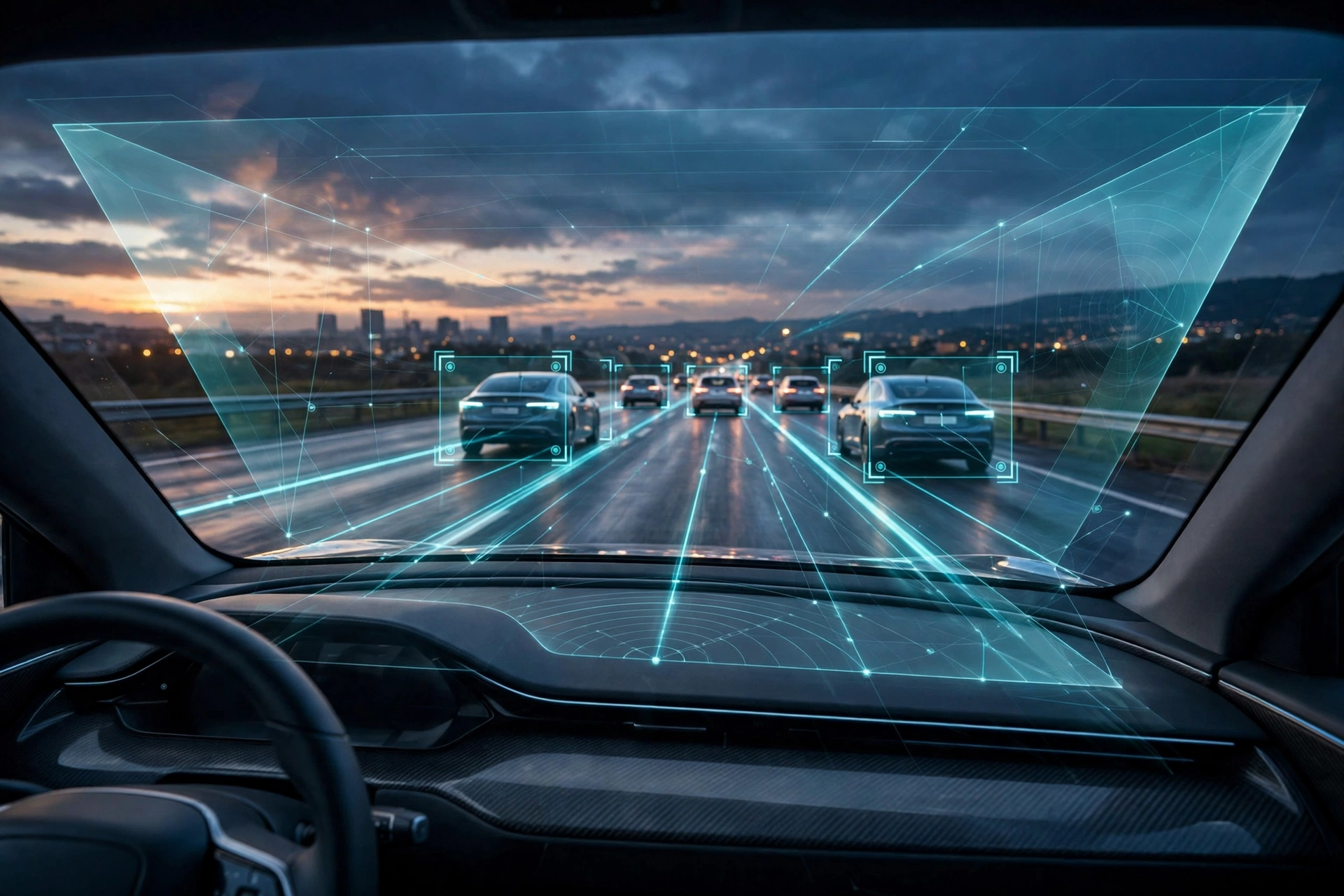
One of the most talked-about features of Tesla FSD v15 is Tesla Reality View, a live generative visualisation of the drive. It shows the driver what the car sees and what it plans to do, using a richer, more realistic rendering of the road ahead.
Previous versions of FSD showed a simplified, schematic view of the road, with other vehicles represented as simple shapes. Reality View aims to present a far more detailed and lifelike picture, giving the driver a clearer sense of the car’s surroundings and its intentions.
Tesla FSD v15: Smarter Detection and Everyday Improvements
Beyond the headline features, Tesla FSD v15 brings practical improvements owners will notice in daily driving, including better detection of road signs, potholes, debris and small animals, helping the car respond more safely to hazards previous versions sometimes missed.
The update also adds speed-camera slowing, which means the car will reduce speed when approaching a speed camera, and a new Bike Rack Mode for owners who carry bicycles on a rear-mounted rack. Bike Rack Mode adjusts the car’s awareness of its own length and the objects behind it, reducing false alerts.
Tesla FSD v15 Is Still Supervised
One fact must be stated clearly. Tesla FSD v15 is still supervised. The driver must stay alert, keep their hands available, and be ready to take over at any moment. The name “Full Self-Driving” has long been controversial, because the system does not drive itself in the way the name suggests.
Regulators continue to watch Tesla’s claims closely, and the company has faced questions about whether its marketing overstates what the software can do. Owners should treat it as a powerful driver assistance system, not as a self-driving car.
AI5, AI4 and the Hardware Question
Tesla’s hardware plans have also been clarified. The company’s next-generation AI5 computer is being developed for the Optimus robot, not for cars, according to Elon Musk, who confirmed this in a reply on X on 22 November. Cars will stay on AI4 for the foreseeable future.
This is reassuring news for owners of Hardware 4 vehicles. It is less encouraging for owners of older Hardware 3 cars, who may find that future FSD updates pass them by, and Tesla has given no firm commitment on upgrading them.
If you own a Hardware 4 Tesla, FSD v15 is coming to you, either now or in December. If you own an older car, the future of your FSD updates remains uncertain.
Source: Electrek — Tesla FSD v15 rollout
Tesla’s progress in driver assistance sits alongside the wider AI story we have been following. For the latest on how AI is reaching consumers, our report on Google’s new generative media model is also worth reading.
Frequently Asked Questions
When did Tesla FSD v15 start rolling out?
Tesla began rolling out FSD v15 on Saturday 21 November 2026 to a first wave of Early Access owners, as version 15.0.1 on software build 2026.38.6.11.
What is the Tesla FSD v15 25x safety claim?
Tesla claims FSD v15 offers 25 times better handling of safety critical cases than the previous version, measured by the critical intervention rate. This is Tesla’s own claim; the company has published no baseline data.
Is Tesla FSD v15 fully self-driving?
No. FSD v15 is still supervised. The driver must stay alert and be ready to take over at any moment. Despite the name “Full Self-Driving”, the system is a driver assistance feature, not a fully autonomous vehicle.
Which cars can get Tesla FSD v15?
FSD v15 is currently limited to cars with Hardware 4, also known as AI4. Older Hardware 3 vehicles are not included in the first wave, and Tesla has not confirmed when or whether they will receive it.
What is Tesla Reality View?
Tesla Reality View is a new live generative visualisation in FSD v15 that shows the driver a richer, more realistic rendering of the road ahead, replacing the simpler schematic display used in previous versions.