Riemann Hypothesis has resisted mathematicians since 1859. On 20 November 2026, a mathematician at Anthropic said he and Claude had found a proof. The claim is extraordinary, the evidence is 17 million lines of computer code, and the maths world is still deciding what it means. The distinction between claimed and verified matters, because this is a $1 million Millennium Prize problem, and no prize has been awarded.
What Is the Riemann Hypothesis?
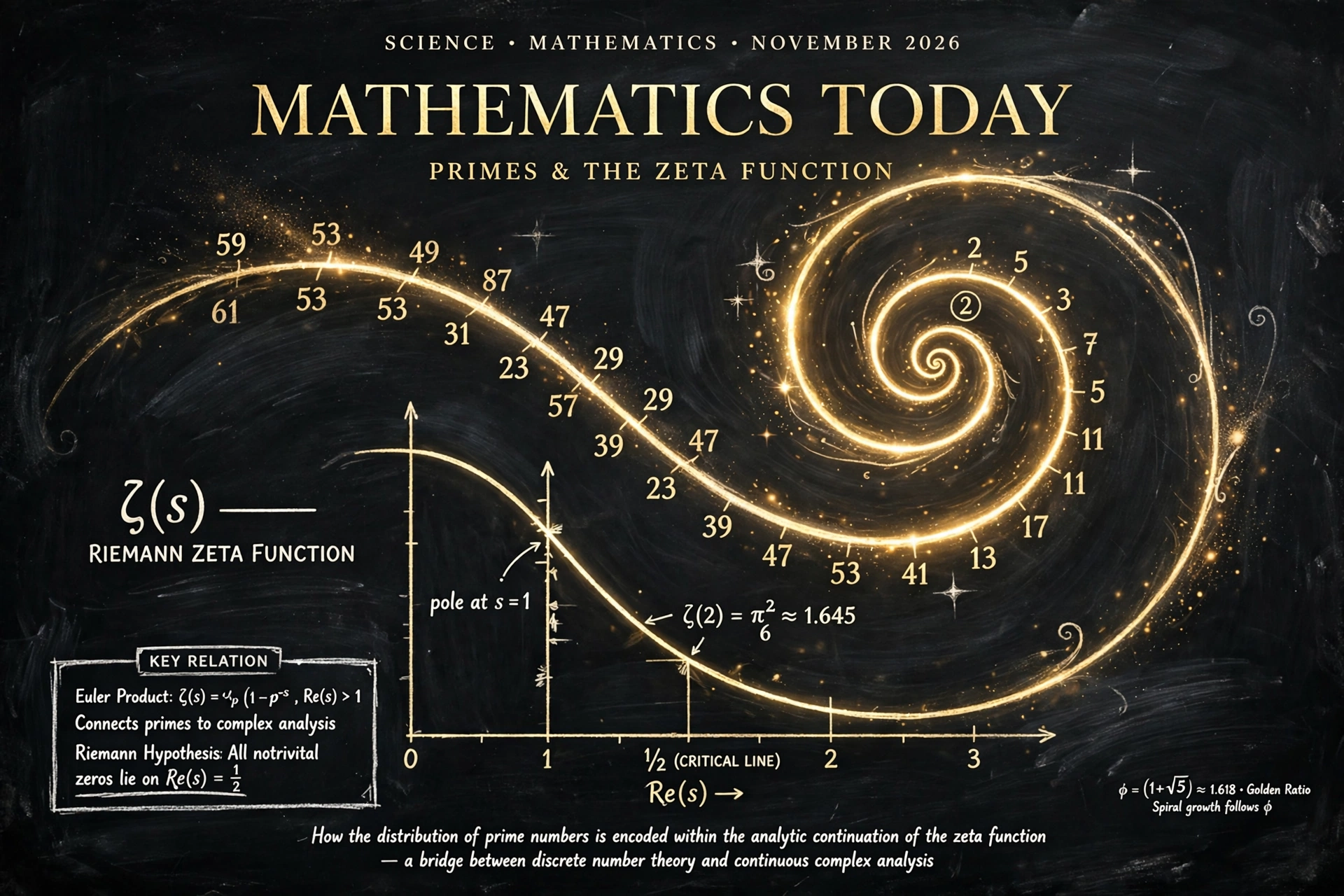
The Riemann Hypothesis is about prime numbers: 2, 3, 5, 7 and the numbers that can only be divided by themselves and 1. Primes are the building blocks of arithmetic, but they appear irregularly as numbers grow.
In 1859, the German mathematician Bernhard Riemann proposed a deep pattern behind that irregularity. In technical terms, the hypothesis says that all the nontrivial zeros of the Riemann zeta function lie on a particular vertical line, where the real part equals one-half.
If true, it would explain how primes are distributed, and it underpins hundreds of other results that begin with the words “assuming the Riemann Hypothesis”. The Clay Mathematics Institute named it one of seven Millennium Prize problems in 2000, each carrying a $1 million prize.
The Riemann Hypothesis Claim: What Happened on 20 November
Levent Alpöge is a number theorist who works at Anthropic, the company behind Claude. On 20 November 2026, he posted a four-page note on his personal website, alpo.ge, with a striking sentence: “I believe I have, working with Claude, discovered a proof of the Riemann Hypothesis.”
His claim goes further: Alpöge says the method also settles the Generalized Riemann Hypothesis, which extends the idea to related functions, and he expects the Extended Riemann Hypothesis to follow.
Alpöge consulted Anthropic chief executive Dario Amodei before announcing, and waited until after Anthropic’s 19 November listing. The work took about six weeks, from the first key step on 6 October to the Generalized Riemann Hypothesis on 16 November.
Riemann Hypothesis Proof: Why the Evidence Is Code, Not a Paper
There is no conventional paper explaining the proof. Alpöge has released the argument only as a formalization in Lean, a programming language and proof assistant that checks mathematical reasoning step by step.
The Lean archive runs to about 17 million lines of code, split across 14 files. Alpöge says an informal draft would run past 250,000 pages, so he chose not to post it.
He is candid about the limits of his own understanding: Alpöge says he has not yet mastered all the mathematics in the argument.
Alpöge credits Claude with major advances, including the idea of chaining transformations called theta lifts about the square root of X times. He says Claude outpaced him near the finish line.
What the Lean and Mathlib Communities Certified
Within a day, the formal proof world moved. On 21 November 2026 at 13:55 UTC, the Lean community blog published a joint statement endorsed by the Lean FRO and the Mathlib Initiative.
The statement says the communities have “full confidence that Alpöge’s proof of the Riemann Hypothesis is correct”. They certified that both the formal statement and the Lean proof are correct.
The certification rests on four checks: the statement is Mathlib’s own vetted statement, the library compiles correctly, the code proves that exact statement, and the exported proof passed several independent checkers.
Andrew Sutherland of MIT reported that lean4lean accepted all 175,187 compiled modules, finishing around 21:55 UTC on 21 November. The five headline theorems depend only on the three standard axioms.
Riemann Hypothesis: What Is Still Not Settled
Machine certification is not the same as a solved problem, and several points remain open.
First, as of 22 November at 16:10 UTC, two long verification runs were still going: the lake comparator end to end, and the Lean kernel replay on the export.
Second, a critique posted on PhilArchive by Jenny Lorraine Nielsen is unaddressed. It asks whether a trivial geometry predicate on the path to the hypothesis statement undermines the classical argument, even when the computer checkers accept the type.
Third, no human has read or understood the full argument. At 17 million lines, no person can: the proof is machine-checked, not human-understood.
Fourth, the Clay Mathematics Institute still lists the prize as open: its rules require publication in a qualifying outlet, followed by at least two years before any award.
There is also a rival claim: Stanford mathematician Ravi Vakil says a Stanford postdoc independently submitted a human proof on the same day.
What Mathematicians Say About the Riemann Hypothesis Claim
Reactions from leading mathematicians have been cautious but intrigued. James Maynard of Oxford said: “I suspect that the proof will turn out to be correct, although even checking the Lean verification will take some time.”
Youness Lamzouri, a professor of mathematics at the University of Lorraine, cautioned that checking the computer-generated proof was only the beginning. Understanding why the proof works is a separate, longer task.
Why This Riemann Hypothesis Claim Matters for AI
Whatever the final verdict, the claim is a landmark for artificial intelligence in mathematics. Earlier AI-assisted breakthroughs solved parts of problems. This claim says an AI helped solve one of the most famous problems in the subject.
Alpöge directed the effort, and Claude supplied major advances, including the central theta lift idea: a genuine collaboration, not a machine working alone.
It also raises hard questions: if a proof is too long for any human to read, what does it mean to know something is true?
Frequently Asked Questions
Has the Riemann Hypothesis been proved?
Not yet, in the settled sense. Alpöge claims he and Claude found a proof, and the Lean and Mathlib communities certified the formal proof as correct. But the Clay Institute still lists the problem as unsolved, a critique is unaddressed, and no human has understood the full argument.
What is the Riemann Hypothesis in simple terms?
The Riemann Hypothesis says that all the nontrivial zeros of the Riemann zeta function lie on a single vertical line. In plain language, it describes a hidden pattern in how prime numbers are distributed.
Who claimed to prove the Riemann Hypothesis?
Levent Alpöge, a mathematician at Anthropic, posted the claim on 20 November 2026 on his personal website. He says he found the proof working with Claude, Anthropic’s AI system.
What is the Riemann Hypothesis prize?
The Clay Mathematics Institute offers $1 million for a solution, one of its seven Millennium Prize problems. Its rules require publication in a qualifying outlet and at least two years before an award.
How was the Riemann Hypothesis proof checked?
The proof was released as Lean code, about 17 million lines. Independent checkers verified the formal proof, and the Lean and Mathlib communities certified it on 21 November 2026.
Conclusion
The Riemann Hypothesis claim is the biggest maths story of 2026. A formal proof has been machine-checked and certified, but the Clay Institute still lists the problem as unsolved, a critique stands unanswered, and no human yet understands the argument. The honest summary: a proof has been claimed and machine-checked, not yet proved in the sense mathematics has always meant.