
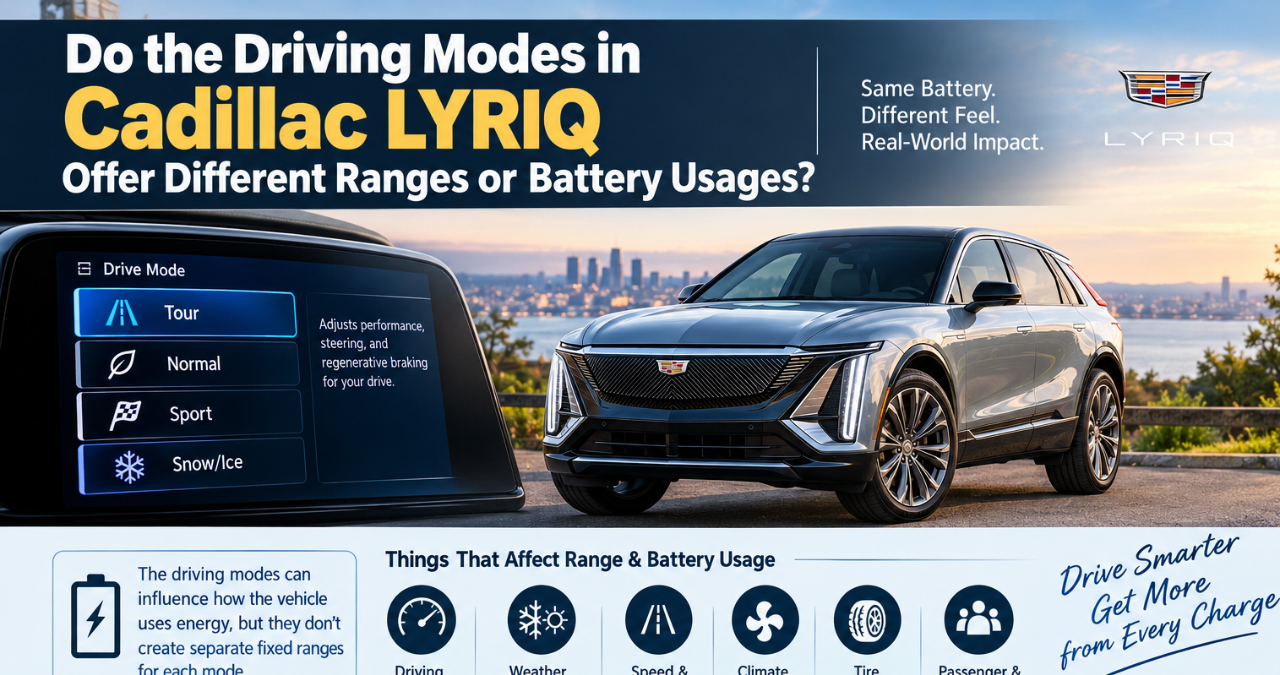
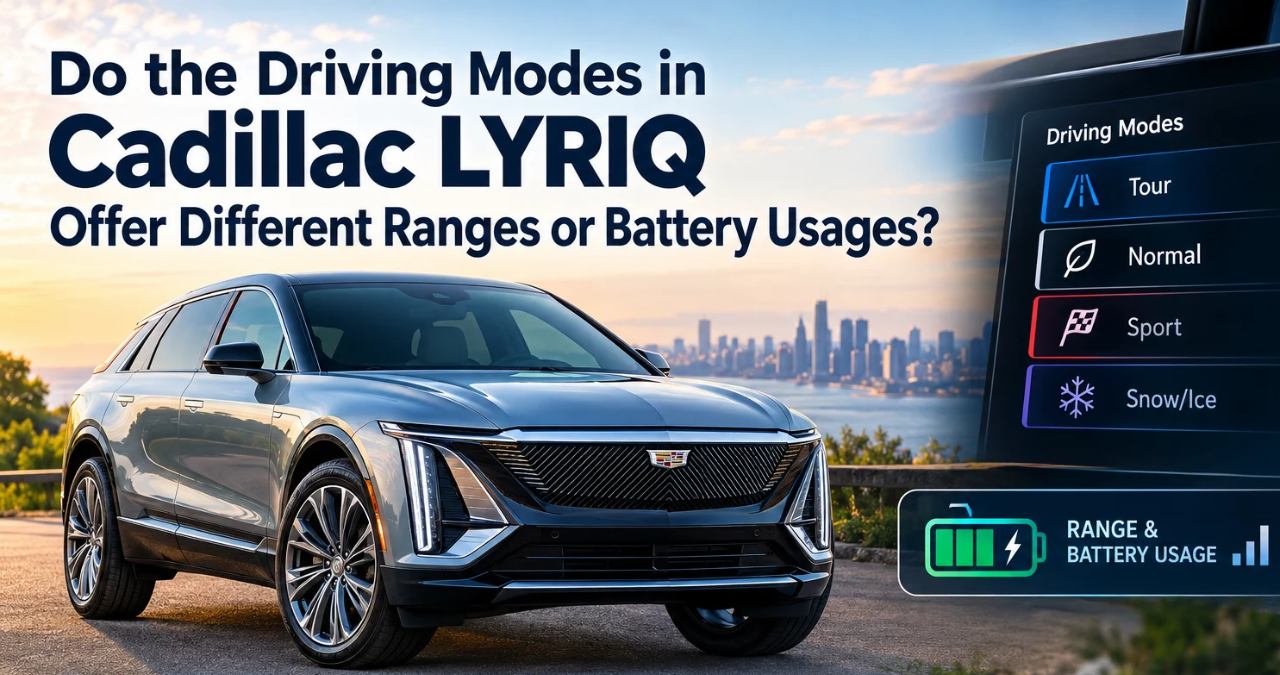
Do the driving modes in Cadillac Lyriq offer different ranges or battery usages? Yes, they can influence how the vehicle uses energy, but the difference isn’t as simple as selecting one mode and automatically receiving a completely different EPA-rated range. The Cadillac LYRIQ’s driving modes change how the vehicle responds to accelerator input, steering, regenerative braking, traction, and other systems. These changes can affect efficiency and, therefore, the amount of battery energy used during a drive.
For electric vehicle owners, this is an important question. Range anxiety can make any trip feel like a calculation, especially when weather, traffic, hills, passengers, and climate control are involved. The good news is that the LYRIQ gives drivers useful ways to adjust the driving experience without requiring complicated technical knowledge.
Understanding these modes can help owners make smarter choices. Whether you’re cruising around town, driving on a highway, or looking for a more responsive experience, knowing how the modes work can make the LYRIQ easier and more enjoyable to drive.
Understanding Cadillac LYRIQ Driving Modes
The Cadillac LYRIQ is designed around an electric powertrain, so its driving behavior is different from that of a traditional gasoline-powered SUV. Instead of shifting through conventional gears, the electric motors deliver power smoothly and quickly.
Driving modes allow the vehicle to adjust certain characteristics of this power delivery and other systems. Depending on model year, trim, and equipment, available modes and their behavior can vary, so owners should always check their specific vehicle’s owner’s manual.
In general, the purpose of driving modes is not to create separate battery sizes or completely separate range ratings. Rather, they provide different ways of controlling the same basic electric powertrain.
A driver might notice differences in:
- Accelerator response
- Regenerative braking behavior
- Steering feel
- Traction and stability responses
- Overall responsiveness
- How quickly the vehicle reacts to driver inputs
These characteristics can indirectly influence energy consumption.
Do the Driving Modes in Cadillac Lyriq Offer Different Ranges or Battery Usages?
The short answer is not in the sense of having a fixed range for each mode.
For example, the LYRIQ doesn’t generally work like this:
| Driving Mode | Fixed Battery Range |
|---|---|
| Normal | One specific range |
| Sport | Another specific range |
| Tour | Another specific range |
Instead, the actual range depends on many variables. A driving mode may encourage or discourage certain driving behaviors, which can change efficiency.
Think of it this way: the battery stores a certain amount of energy, but the rate at which that energy is consumed depends heavily on how the vehicle is driven.
A more aggressive driving style can use more electricity. Smooth acceleration and steady speeds can use less. Therefore, a performance-focused mode may result in higher consumption when the driver takes advantage of its sharper response.
That distinction matters.
The mode itself isn’t necessarily draining the battery dramatically just because it’s selected. Driver behavior remains one of the biggest factors.
How Driving Style Affects LYRIQ Battery Consumption
Electric vehicles are particularly sensitive to driving conditions and habits. That’s because electric motors can deliver substantial torque immediately.
If you press the accelerator gently, the vehicle can build speed smoothly. If you push hard, the motors can deliver strong acceleration, which requires more electrical energy.
Several driving habits can affect battery usage:
- Rapid acceleration
- High-speed highway driving
- Frequent hard braking
- Heavy climate-control use
- Carrying extra weight
- Driving uphill
- Cold or extremely hot temperatures
- Strong headwinds
- Low tire pressure
A driver using a responsive driving mode might naturally accelerate more enthusiastically. As a result, electricity consumption can rise.
On the other hand, someone using the same mode carefully could still achieve reasonable efficiency.
So, there’s no magic button that automatically cuts the LYRIQ’s range in half or doubles battery life.
What Happens in a More Performance-Oriented Mode?
A performance-oriented setting is generally designed to make the vehicle feel more responsive. The accelerator may feel sharper, and the vehicle may respond more quickly to driver inputs.
That’s great when you want a lively driving experience.
However, there is a trade-off. When drivers repeatedly use the vehicle’s strong acceleration, the battery has to provide more power. The result can be greater energy consumption.
Imagine two LYRIQ drivers starting with the same battery level.
One driver accelerates gradually and maintains a steady speed.
The other repeatedly accelerates hard because the vehicle’s instant electric torque is tempting.
Even if both vehicles are in the same driving mode, the second driver may consume noticeably more energy.
This is why it would be misleading to say that a particular mode always produces a specific range.
How Regenerative Braking Can Influence Efficiency
Regenerative braking is one of the most important concepts for understanding electric vehicle efficiency.
When an EV slows down, its electric motor can operate as a generator. Instead of allowing all the vehicle’s kinetic energy to disappear as heat through conventional friction brakes, some energy can be recovered and sent back into the battery.
The LYRIQ uses regenerative braking technology as part of its electric driving system.
However, regeneration doesn’t mean that braking is completely free. Energy is always lost during conversion. You can’t recover every bit of energy used to accelerate the vehicle.
Still, regenerative braking can help improve overall efficiency, particularly during stop-and-go driving.
Driving modes and other controls can influence how the vehicle feels when it slows down. Depending on the configuration, drivers may experience different levels of deceleration or different responses when lifting off the accelerator.
City Driving Versus Highway Driving
Where you drive often matters more than which mode you select.
City driving includes frequent:
- Stops
- Starts
- Turns
- Traffic lights
- Speed changes
Regenerative braking can be especially useful in these situations.
Highway driving is different. Once the LYRIQ reaches a steady cruising speed, there may be fewer opportunities to recover energy through braking.
Air resistance also becomes increasingly important as speed rises. That’s why maintaining a very high highway speed can reduce EV range considerably.
In simple terms, the difference between driving modes may be smaller than the difference created by changing from calm city driving to fast highway driving.
Climate Control and Its Effect on Battery Usage
Many people focus entirely on the motor when thinking about EV range. However, the battery also powers other systems.
Heating and cooling can consume significant electricity, particularly in extreme weather.
On a hot day, the LYRIQ may need substantial energy to cool the cabin. During cold weather, heating the interior can also affect efficiency.
This means two drivers using the same driving mode can experience different range.
For example:
Driver A
- Mild weather
- Moderate speed
- Light climate-control use
- Smooth acceleration
Driver B
- Very hot weather
- Strong air conditioning
- High highway speed
- Frequent acceleration
Driver B may use substantially more battery energy even though both vehicles have the same battery and driving mode.
That’s why the displayed range should be treated as an estimate rather than a guarantee.
Battery Size Doesn’t Change With Driving Mode
One important point deserves special attention: selecting a different driving mode doesn’t physically change the size of the LYRIQ’s battery.
The battery pack remains the same.
What changes is how the vehicle manages its systems and responds to the driver.
Think of the battery as a water tank. Selecting a driving mode doesn’t make the tank larger or smaller. Instead, your driving behavior can change how quickly water flows out of it.
This analogy isn’t perfect, but it makes the basic idea easy to understand.
The vehicle’s battery capacity, state of charge, temperature, age, and condition remain important factors.
Does Sportier Driving Always Mean Less Range?
Not necessarily.
This is one of the most common misunderstandings about driving modes.
A sportier setting can encourage more energetic driving, but simply selecting it doesn’t guarantee a dramatic range reduction.
Suppose you select a more responsive mode but drive gently. Your energy consumption could remain fairly reasonable.
Now suppose you select a comfort-oriented mode but drive at high speeds with frequent hard acceleration. Your consumption could still be high.
In other words, your right foot matters a lot.
Driving mode is one piece of the puzzle, not the whole puzzle.
Factors That Have a Bigger Effect on Range
If you’re trying to maximize LYRIQ range, don’t focus only on driving modes. Consider the complete driving environment.
Speed
High speeds increase aerodynamic resistance. As speed increases, the vehicle generally needs more energy to maintain that speed.
Acceleration
Hard acceleration can consume more electricity than smooth acceleration.
Temperature
Very hot and very cold conditions can reduce efficiency because the vehicle must spend energy managing the battery and cabin temperature.
Tires
Properly inflated tires can help reduce rolling resistance.
Terrain
Climbing hills requires additional energy. Descending can allow some energy recovery through regenerative braking.
Passenger and Cargo Weight
Extra weight requires additional energy, particularly during acceleration and uphill driving.
Wind
A strong headwind can make the motor work harder. A tailwind can have the opposite effect.
Traffic
Constant stop-and-go traffic can affect efficiency, although regenerative braking can recover some energy during deceleration.
Comparing Common Driving Situations
The following table gives a simple overview of how different situations may affect battery usage.
| Driving Situation | Likely Energy Effect | Why |
|---|---|---|
| Gentle city driving | Moderate | Frequent braking can support regeneration |
| Aggressive acceleration | Higher usage | More power is demanded from the battery |
| Steady moderate-speed cruising | Often efficient | Smooth operation reduces unnecessary energy use |
| Very high-speed highway driving | Higher usage | Aerodynamic drag rises with speed |
| Long uphill drive | Higher usage | Extra energy is needed to climb |
| Downhill driving | Potential recovery | Regenerative braking may recover some energy |
| Heavy climate-control use | Higher usage | Heating or cooling requires electricity |
| Smooth driving | Generally favorable | Less energy is wasted through abrupt inputs |
These are general principles rather than promises of specific range figures.
Why the LYRIQ’s Estimated Range Can Change
The estimated range shown by an electric vehicle isn’t simply a countdown based on battery percentage.
The vehicle can use recent driving information and operating conditions to estimate how far the remaining battery energy might take you.
As your driving pattern changes, the estimate can change too.
For example, you might start a trip with a relatively optimistic range estimate. After spending an hour at high speed with heavy air conditioning, the estimate could decrease faster than the distance traveled.
That doesn’t necessarily mean something is wrong.
The computer is responding to changing energy consumption.
Similarly, efficient driving can sometimes make the estimated range decline more slowly.
How Drivers Can Improve LYRIQ Efficiency
If your goal is to get the most usable distance from each charge, a few simple habits can help.
Accelerate Smoothly
Electric vehicles don’t need dramatic throttle inputs to move quickly. Gradual acceleration can help reduce unnecessary energy use.
Maintain a Reasonable Highway Speed
High-speed driving is one of the easiest ways to increase EV energy consumption.
Use Regenerative Braking Wisely
Learning how the LYRIQ slows down can help you make better use of regenerative braking.
Plan Ahead
Avoiding unnecessary detours and heavy traffic can help.
Check Tire Pressure
Correct tire pressure supports efficient operation and good handling.
Manage Cabin Temperature
Preconditioning the cabin while connected to a charger, when supported and appropriate, can help reduce the need to use battery energy for initial heating or cooling during the trip.
Remove Unnecessary Weight
You don’t need to carry everything in the vehicle all the time. Extra cargo adds weight.
Is a Comfort-Oriented Mode Better for Range?
It can be useful for efficiency-minded driving, but it shouldn’t be viewed as a guaranteed “maximum range” switch.
A comfort-focused setting may encourage smoother vehicle behavior. If that leads you to accelerate and decelerate gently, you may see favorable energy consumption.
But driving conditions still matter.
A driver using a comfort mode at very high speeds can consume more electricity than someone using another mode while driving calmly at moderate speeds.
That’s why it’s better to think of driving modes as tools for changing vehicle behavior, rather than fixed range settings.
What About One-Pedal Driving?
One-pedal-style driving is another feature that can influence the driving experience in an electric vehicle.
The basic idea is simple: lifting off the accelerator can produce noticeable deceleration, reducing the need to use the brake pedal in many situations.
Depending on the LYRIQ configuration and selected settings, regenerative braking behavior can contribute to this driving experience.
One-pedal driving can feel strange at first, especially for people coming from gasoline-powered vehicles. After some practice, however, many EV drivers find it intuitive.
It can also make city driving smoother because the driver can control speed largely through accelerator input.
Still, regeneration shouldn’t be confused with free energy. Energy recovery is helpful, but avoiding unnecessary acceleration in the first place is generally more efficient than accelerating and then relying on regeneration to slow down.
Does Regeneration Fully Recharge the Battery?
No.
Regenerative braking can recover some energy, but it can’t return all the electricity used to accelerate the vehicle.
There are unavoidable losses in the process.
Energy is lost through:
- Electrical resistance
- Motor and inverter losses
- Battery charging losses
- Tire resistance
- Air resistance
- Mechanical losses
That’s why efficient EV driving isn’t about constantly accelerating and regenerating.
Instead, the goal is to drive smoothly and avoid unnecessary energy changes whenever possible.
Understanding Battery Percentage and Range
The battery percentage tells you approximately how much charge remains.
The estimated range tells you how far the vehicle expects that remaining energy to take you under current conditions.
These are related, but they’re not identical.
For instance, having a certain percentage of battery remaining doesn’t guarantee a fixed number of miles or kilometers.
The vehicle might estimate a different remaining distance depending on:
- Recent energy consumption
- Weather
- Driving conditions
- Speed
- Terrain
- Climate-control usage
- Vehicle load
That’s perfectly normal for an electric vehicle.
Driving Modes and Long-Term Battery Health
Another useful question is whether frequently changing driving modes can damage the battery.
Generally, changing between normal driving modes isn’t inherently harmful to the battery. The LYRIQ is designed to manage its electric powertrain electronically.
However, battery longevity is influenced by broader factors such as temperature, charging practices, usage patterns, and battery management.
Drivers shouldn’t be afraid to enjoy the LYRIQ’s performance.
After all, an EV is supposed to be driven.
The smart approach is simply to understand that aggressive acceleration can consume more energy and may reduce the distance available on that charge.
Common Myths About LYRIQ Driving Modes
There are several misconceptions worth clearing up.
Myth: Every Mode Has Its Own Official Range
Not necessarily. Range ratings are not simply assigned as one permanent number to each driving mode.
Myth: Sport Mode Always Drains the Battery Quickly
Not automatically. Driving style, speed, terrain, weather, and climate control can have a much larger effect.
Myth: Regenerative Braking Creates Free Electricity
No. It recovers some energy that would otherwise be lost, but it doesn’t eliminate energy losses.
Myth: A Full Battery Always Gives the Same Distance
No. Real-world range changes with conditions.
Myth: Changing Modes Changes Battery Capacity
No. The physical battery capacity doesn’t change because you selected another driving setting.
How to Choose the Right Mode
There’s no single best mode for every trip.
Instead, think about what you’re trying to accomplish.
For relaxed everyday driving:
Choose a setting that gives you smooth and predictable responses.
For enthusiastic driving:
A more responsive setting can make the LYRIQ feel more engaging, but expect energy consumption to rise if you use the extra performance frequently.
For maximizing practical range:
Focus less on the mode name and more on smooth acceleration, reasonable speeds, tire pressure, climate management, and trip planning.
This approach gives you the best of both worlds: you can enjoy the vehicle without unnecessarily wasting battery energy.
A Practical Range-Saving Strategy
If you’re heading out on a long journey, consider this simple routine:
- Start with an appropriate state of charge.
- Check the planned route.
- Look at charging opportunities.
- Precondition the vehicle when practical.
- Avoid unnecessary high-speed driving.
- Accelerate smoothly.
- Use regenerative braking effectively.
- Keep tires properly inflated.
- Reduce unnecessary cargo.
- Watch your energy-consumption information during the journey.
After a few trips, you’ll begin to understand how your own driving style affects the LYRIQ.
That’s arguably more useful than memorizing a single advertised range figure.
Why Real-World Testing Matters
Official range estimates are useful for comparing vehicles, but real-world driving is more complicated.
Two owners can operate identical LYRIQ models and achieve different results.
One might live in a mild climate and drive mostly at moderate speeds. Another might regularly travel at high highway speeds in extreme heat.
Neither driver is necessarily doing anything wrong.
The difference comes from operating conditions.
That’s why experienced EV owners pay attention to energy consumption over time rather than becoming overly concerned about every small change in the range estimate.
When to Check the Owner’s Manual
The LYRIQ has evolved across model years and configurations. Equipment, software, available settings, and control behavior can differ.
If you’re unsure about exactly how a particular mode works on your vehicle, the owner’s manual is the best source.
It’s especially important to check the manual for:
- Your model year
- Your specific trim
- Available drive modes
- Regenerative braking controls
- One-pedal driving functions
- Charging recommendations
- Battery-related warnings
- Energy-use displays
Online discussions can be useful, but your vehicle’s official documentation should take priority when the details matter.
Frequently Asked Questions
Can driving mode change the Cadillac LYRIQ’s official range?
Driving modes don’t generally create separate fixed EPA range ratings. Actual energy consumption can vary depending on the mode, how it’s used, and the driving conditions.
Does Sport-style driving use more battery?
It can, particularly when the driver frequently uses strong acceleration and higher speeds. The mode itself isn’t the only factor.
Does regenerative braking increase range?
It can improve overall efficiency by recovering some energy during deceleration. However, it can’t recover all the energy used to accelerate.
Is the most relaxed mode always the most efficient?
Not necessarily. A driver’s speed, acceleration habits, weather, terrain, and climate-control use can have a larger effect.
Can changing modes damage the battery?
Normal use of the vehicle’s available driving modes isn’t inherently expected to damage the battery. The vehicle’s battery management system is designed to control operation.
Why does my estimated range change while I’m driving?
The estimated range can respond to recent energy consumption and changing conditions. Faster driving, hills, weather, and climate-control use can all affect the estimate.
Is highway driving more demanding on battery range?
Highway driving at elevated speeds can use more energy because aerodynamic resistance increases significantly with speed.
Final Thoughts on LYRIQ Efficiency
The answer to do the driving modes in Cadillac Lyriq offer different ranges or battery usages? is best understood as yes, driving modes can influence energy consumption, but they don’t normally provide separate fixed battery ranges. The bigger picture matters much more.
Your speed, acceleration, road conditions, temperature, climate-control use, terrain, tires, vehicle load, and driving habits all work together to determine how much energy the LYRIQ uses. A more responsive mode can encourage stronger acceleration, which may increase consumption, while smoother driving can help preserve energy.
The key takeaway is simple: don’t be afraid to use the LYRIQ’s different driving modes. They’re there to make the vehicle more flexible and enjoyable. If maximum range is your priority, focus on smooth driving, sensible speeds, good tire pressure, smart climate management, and thoughtful trip planning. In the end, do the driving modes in Cadillac Lyriq offer different ranges or battery usages? They can affect battery usage indirectly, but your driving conditions and habits remain the biggest pieces of the range puzzle.
You may also read
Ibiza Nightlife: A Complete Guide to Music, Clubs, Beaches, and After-Dark Fun