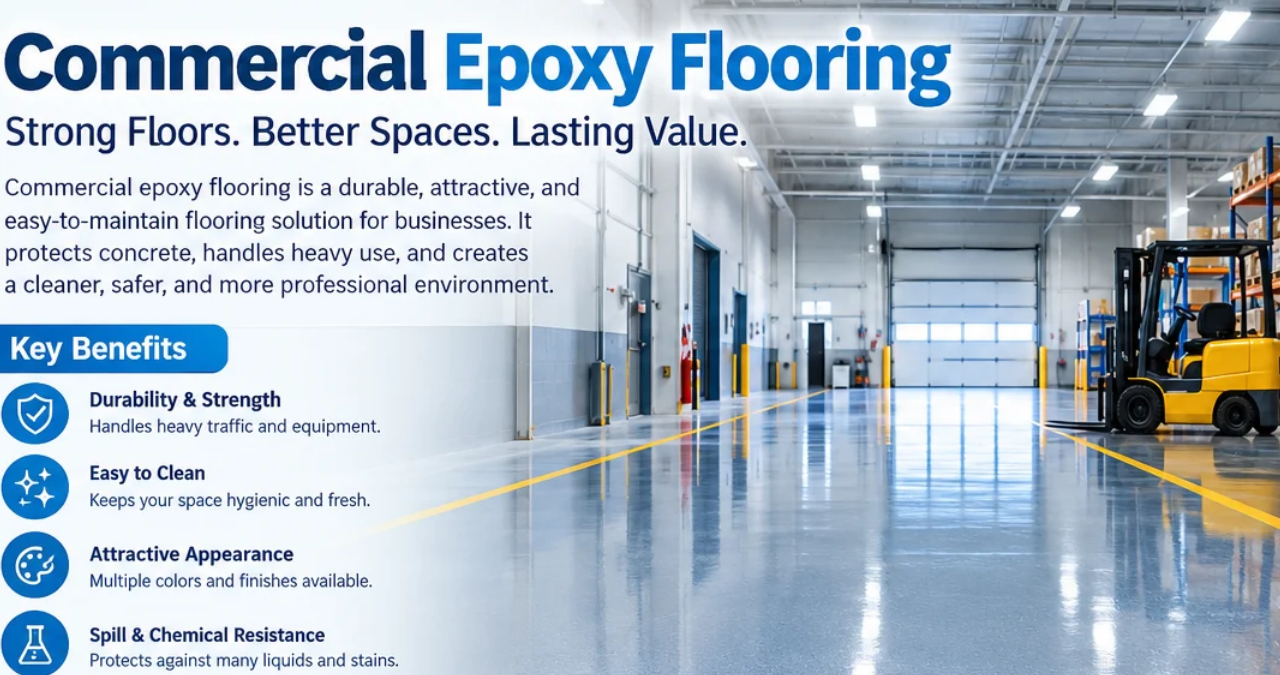
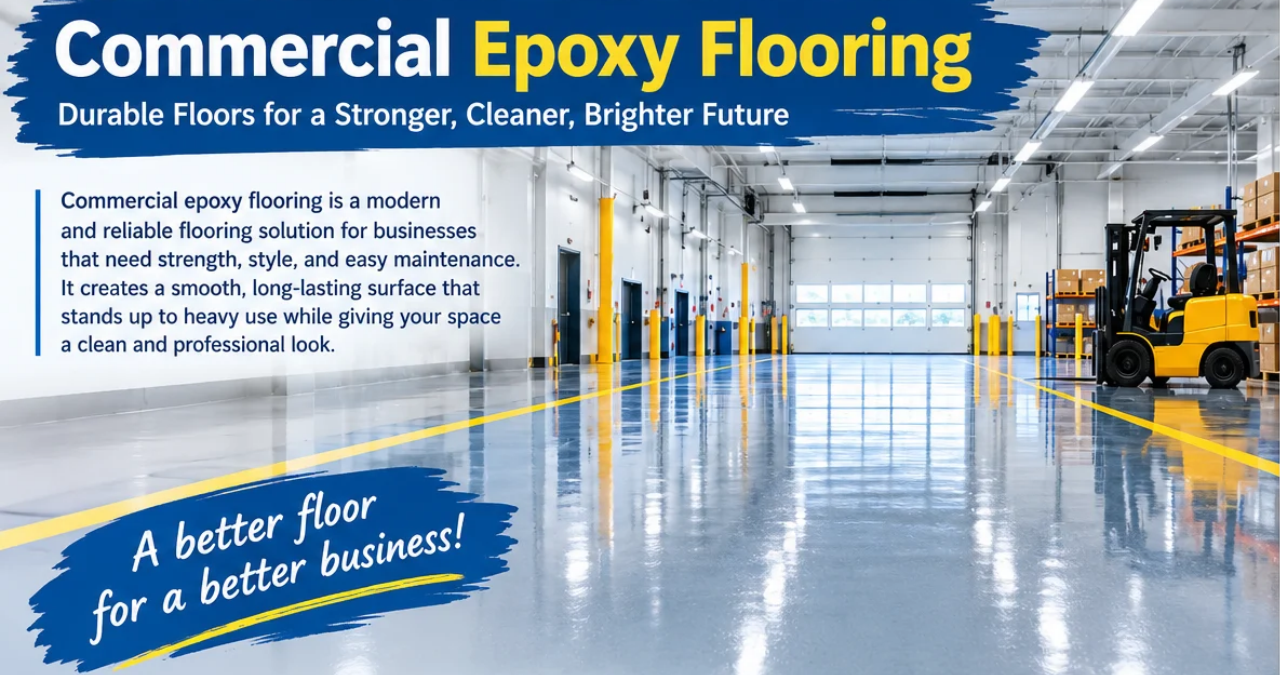
Commercial epoxy flooring has become a popular choice for businesses that need a strong, attractive, and easy-to-maintain floor. From warehouses and factories to retail stores, hospitals, garages, restaurants, and offices, epoxy flooring can provide a smooth surface that handles heavy daily use. Unlike ordinary flooring materials that may wear down quickly under demanding conditions, epoxy systems are designed to create a durable protective layer over concrete floors.
Choosing the right floor is more than simply picking a color or finish. A commercial floor must deal with foot traffic, equipment, spills, cleaning, moisture, and sometimes heavy vehicles. That’s where commercial epoxy flooring can make a real difference. When properly selected, prepared, and installed, it can improve both the appearance and performance of a business environment.
This guide explains what epoxy flooring is, how it works, where it can be used, its main advantages, installation considerations, maintenance needs, costs, and important factors to consider before making a decision.
What Is Commercial Epoxy Flooring?
Commercial epoxy flooring is a protective floor coating made by combining epoxy resin with a hardening agent. When these materials are mixed, they create a chemical reaction that forms a hard and durable surface. The coating is normally applied over prepared concrete, where it bonds with the floor and creates a seamless finish.
Unlike ordinary paint, epoxy is designed to form a much stronger layer. Depending on the product and installation system, an epoxy floor may include a primer, body coat, decorative elements, and a protective topcoat. The exact system depends on the needs of the building.
A properly installed epoxy floor can provide:
- A smooth and professional appearance
- Resistance to everyday wear
- Protection against many spills and stains
- Easier cleaning
- Improved floor durability
- A wide range of colors and finishes
- Better light reflection in some environments
- Reduced dust from worn concrete surfaces
The key point is that epoxy flooring isn’t simply about making concrete look better. It can also help protect the underlying surface and create a more practical working environment.
Why Businesses Choose Commercial Epoxy Flooring
Businesses operate under pressure. Floors are exposed to people, machinery, carts, forklifts, chemicals, dirt, moisture, and constant movement. Naturally, a flooring system that can handle these conditions is valuable.
One major reason companies choose epoxy is its combination of strength and appearance. A warehouse, for example, may need a surface that can withstand forklifts while still looking organized and clean. A showroom may want the same durability but with a more polished decorative finish.
Another advantage is that epoxy can be customized for different commercial environments. Some businesses need slip-resistant textures, while others may prioritize chemical resistance, decorative flakes, bright colors, or safety markings.
In other words, one flooring material can serve many purposes when the correct system is selected.
Key Benefits of Commercial Epoxy Flooring
There are several reasons epoxy continues to attract attention in commercial construction and renovation projects. Its benefits can make it a practical alternative to many traditional flooring options.
Durability and Strength
Commercial floors often experience significant traffic. Workers may walk across the same areas hundreds of times a day, while equipment can place additional stress on the surface.
Epoxy creates a strong bonded coating that can protect concrete from many forms of everyday wear. The exact level of durability depends on the thickness, formulation, installation quality, and conditions in the facility.
For high-traffic environments, choosing a professional-grade system is especially important. A cheap coating may not deliver the same performance as a system designed for industrial or commercial use.
Easy Cleaning
Keeping a business clean is easier when the floor has a smooth, seamless surface.
Concrete can contain pores and small imperfections where dirt and liquids collect. Epoxy can create a sealed surface that is generally easier to sweep and mop.
This can be particularly useful in:
- Food preparation areas
- Healthcare facilities
- Retail spaces
- Workshops
- Warehouses
- Automotive facilities
- Commercial kitchens
Of course, cleaning requirements vary by industry. Businesses should always follow the maintenance recommendations provided for their particular epoxy system.
Attractive Appearance
A commercial floor doesn’t have to look dull or industrial.
Epoxy systems are available in many colors and decorative styles. Decorative flakes, metallic effects, borders, patterns, and different gloss levels can be used to create a distinctive appearance.
For customer-facing businesses, appearance matters. A clean, bright, well-maintained floor can contribute to the overall impression of a facility.
Protection Against Spills
Commercial spaces may deal with oils, cleaning products, food substances, water, and other liquids. Depending on the epoxy formulation, the coating can provide useful resistance against various substances.
However, it’s important not to assume that every epoxy product is resistant to every chemical. If a facility regularly handles aggressive chemicals, the flooring system should be selected specifically for those conditions.
Improved Workplace Organization
Epoxy flooring can also support better visual organization.
Different colors can be used to distinguish work areas, walkways, storage zones, or safety boundaries. Floor markings can help guide employees and equipment through large facilities.
This is especially useful in warehouses and manufacturing environments where clear movement paths are important.
Where Commercial Epoxy Flooring Can Be Used
One of the strongest features of epoxy flooring is its versatility. It can be used in a wide variety of commercial settings.
Warehouses and Distribution Centers
Warehouses deal with constant movement. Forklifts, pallet jacks, carts, employees, and stored materials can place considerable demands on the floor.
Epoxy can provide a durable and easy-to-clean surface when the concrete substrate and coating system are properly prepared.
Bright floor colors and markings can also help define pedestrian areas, equipment routes, and storage sections.
Manufacturing Facilities
Factories often require flooring that can handle heavy use and industrial conditions.
Depending on the application, epoxy systems can provide resistance to abrasion, moisture, stains, and selected chemicals. Specialized systems can also be designed for particular industrial requirements.
Before installation, the facility should identify the types of machinery, chemicals, temperatures, and traffic the floor will experience.
Retail Stores
Retail flooring needs to look good while handling customer traffic.
Epoxy can create a clean, polished appearance that works well with modern retail designs. Different colors and decorative finishes allow businesses to create flooring that supports their brand and interior design.
Hospitals and Healthcare Facilities
Healthcare spaces require careful attention to cleanliness and maintenance.
A seamless floor can reduce places where dirt and debris might collect. Depending on the selected system, epoxy flooring can be suitable for areas that need frequent cleaning.
Healthcare facilities should select flooring products based on their specific hygiene, slip-resistance, chemical, and maintenance requirements.
Restaurants and Commercial Kitchens
Restaurant floors can face grease, spills, heat, moisture, and heavy foot traffic.
A suitable commercial flooring system can help create a surface that is easier to clean and maintain. Slip resistance is particularly important in areas where water or grease may be present.
Not every epoxy system is appropriate for every kitchen environment, so professional product selection is essential.
Automotive Shops and Garages
Automotive environments can be rough on flooring. Oil, grease, tires, tools, and vehicle traffic can all contribute to wear.
Epoxy coatings are often considered for garages and service areas because they can create a sealed, attractive surface that is easier to clean than unfinished concrete.
Types of Commercial Epoxy Flooring
There isn’t just one type of epoxy flooring. Different systems are designed for different environments and performance requirements.
Solid Color Epoxy
Solid color epoxy provides a simple and professional appearance. It’s often selected for warehouses, workshops, production spaces, and utility areas.
Colors can also be used for visual organization and safety purposes.
Decorative Flake Epoxy
Decorative flake systems include small colored flakes broadcast into the coating. These flakes can create texture and visual interest while helping disguise minor dirt and everyday marks.
They’re commonly considered for showrooms, offices, retail environments, garages, and customer-facing areas.
Metallic Epoxy
Metallic epoxy can create a more decorative and artistic appearance. It uses special pigments to produce flowing patterns and visual depth.
This style may be suitable for showrooms, lobbies, restaurants, and other spaces where appearance is a major consideration.
Anti-Slip Epoxy
Smooth floors can become slippery when contaminated by water, oil, or other liquids. Anti-slip additives or textured finishes can improve traction.
The right level of slip resistance depends on the environment. A commercial kitchen, wet processing area, and dry office don’t necessarily require the same floor texture.
Heavy-Duty Epoxy Systems
High-demand facilities may require thicker or specially formulated flooring systems.
Heavy-duty systems can be designed for environments involving heavy equipment, frequent vehicle traffic, impact, abrasion, or demanding industrial conditions.
The correct system should be selected according to the actual load and operating conditions rather than simply choosing the thickest available coating.
How Commercial Epoxy Flooring Is Installed
Professional installation is one of the most important parts of a successful epoxy flooring project. Even an excellent product can perform poorly if the concrete isn’t prepared correctly.
Inspecting the Concrete
The existing floor should be inspected before work begins.
Professionals may look for:
- Cracks
- Moisture problems
- Weak concrete
- Oil contamination
- Surface damage
- Previous coatings
- Uneven areas
- Expansion joints
The condition of the substrate plays a major role in the final result.
Preparing the Surface
Surface preparation is often considered one of the most critical steps.
The concrete may be mechanically prepared through methods such as grinding or other appropriate techniques. The goal is to remove contaminants and create a suitable surface for bonding.
Any cracks or damaged sections may also need repair before coating.
Applying the Primer
Depending on the system, a primer may be applied to improve adhesion and prepare the surface for subsequent coats.
The product manufacturer’s instructions should always determine the appropriate primer and application process.
Applying the Epoxy Coating
The epoxy components are mixed according to the manufacturer’s specifications and then applied to the prepared surface.
The installer must pay attention to mixing ratios, working time, temperature, humidity, and application thickness. Small mistakes at this stage can affect the finished floor.
Adding Decorative or Safety Features
If the project includes decorative flakes, color zones, logos, lines, or anti-slip materials, these are incorporated according to the chosen system.
Finally, a topcoat may be applied to provide additional protection and achieve the desired appearance.
Factors That Affect Commercial Epoxy Flooring Performance
Several factors determine how well an epoxy floor performs over time.
Concrete Condition
A coating is only as reliable as the surface underneath it. Crumbling, contaminated, or excessively damp concrete can create problems.
Proper inspection and preparation are therefore essential.
Moisture
Moisture beneath a coating can cause adhesion problems or other flooring failures. Before installation, the moisture condition of the concrete should be evaluated using appropriate testing methods.
If moisture is a concern, a suitable moisture-control solution may be required.
Traffic Levels
A small office and a busy warehouse don’t place the same demands on a floor.
Consider:
- Number of employees
- Vehicle traffic
- Forklift use
- Equipment weight
- Impact exposure
- Frequency of cleaning
These details help determine which flooring system is appropriate.
Chemical Exposure
Businesses that use chemicals should provide installers with information about the substances involved.
A coating that works well in an office may not be suitable for an industrial chemical-processing environment.
Commercial Epoxy Flooring vs. Traditional Concrete
Concrete is a dependable construction material, but unfinished concrete isn’t always ideal as a final commercial floor surface.
Epoxy can provide several improvements:
| Feature | Uncoated Concrete | Commercial Epoxy Flooring |
|---|---|---|
| Appearance | Basic and industrial | Customizable |
| Cleaning | Can be more difficult | Generally easier |
| Dust | May produce surface dust | Sealed surface can reduce dust |
| Chemical resistance | Depends on concrete and exposure | Depends on epoxy formulation |
| Color choices | Limited | Wide selection |
| Safety markings | Possible | Can be incorporated into design |
| Maintenance | May require repairs | Routine maintenance is often simpler |
| Custom finishes | Limited | Many options available |
This comparison doesn’t mean epoxy is automatically better for every situation. The best flooring choice depends on the building, budget, traffic, exposure, and performance requirements.
Maintenance Tips for Commercial Epoxy Flooring
A quality epoxy floor still needs regular care.
Routine maintenance may include:
- Sweeping or dust mopping regularly
- Cleaning spills promptly
- Using appropriate cleaning products
- Avoiding harsh chemicals unless approved
- Removing abrasive debris
- Checking for damaged areas
- Following the manufacturer’s maintenance instructions
Heavy dirt and grit can act like sandpaper under vehicle or foot traffic. Keeping the surface clean can therefore help preserve its appearance.
Businesses should also address damage early. A small problem can sometimes be easier and less expensive to repair than a larger area of deterioration.
Common Mistakes to Avoid
Installing epoxy flooring isn’t a job where cutting corners usually pays off.
One common mistake is applying epoxy to poorly prepared concrete. Dirt, oil, moisture, old coatings, or weak concrete can interfere with adhesion.
Another mistake is choosing a product based only on price. Commercial flooring is a long-term investment, so the cheapest option isn’t necessarily the most economical.
Businesses should also avoid ignoring environmental conditions. Temperature and humidity can affect curing and application.
Other mistakes include:
- Skipping moisture testing when needed
- Using an unsuitable coating for chemical exposure
- Applying the wrong thickness
- Ignoring cracks in the concrete
- Using incompatible cleaning products
- Allowing traffic before proper curing
- Hiring inexperienced installers for complex projects
When in doubt, professional advice can save a lot of headaches later.
How Much Does Commercial Epoxy Flooring Cost?
The cost of an epoxy flooring project can vary considerably. There isn’t one universal price because every building has different requirements.
Factors that can influence total cost include:
- Floor size
- Condition of the concrete
- Surface preparation requirements
- Epoxy system selected
- Coating thickness
- Decorative features
- Repairs
- Moisture-control requirements
- Labor rates
- Project location
- Downtime requirements
A simple coating over a clean, well-prepared floor will generally involve different costs than a heavy-duty industrial system requiring extensive repairs and preparation.
For an accurate estimate, businesses should request an on-site assessment and a detailed written quotation. The quote should clearly explain preparation, materials, coating layers, repairs, curing requirements, and warranty terms where applicable.
How to Choose the Right Commercial Epoxy Flooring Contractor
The installer can be just as important as the product.
Before hiring a contractor, businesses should ask about previous commercial projects and the type of flooring systems they install.
A reliable contractor should be able to explain the process clearly rather than simply giving a price.
Look for:
- Relevant commercial experience
- Knowledge of concrete preparation
- Clear project specifications
- Appropriate safety practices
- Product information
- Written quotations
- Realistic timelines
- References or examples of previous work
- Clear warranty information
It’s also wise to ask what happens if the existing concrete has moisture, cracks, or other problems. A contractor who discusses these issues openly is generally more helpful than someone who promises a perfect result without inspecting the floor.
Environmental and Safety Considerations
Modern businesses increasingly care about sustainability and indoor environmental quality.
Epoxy systems vary in their chemical composition and emissions. Some products are designed to meet specific environmental or indoor-air requirements. Businesses should review technical documentation and select products appropriate for the intended space.
During installation, workers should follow product safety requirements. Proper ventilation, protective equipment, mixing procedures, and curing times are important.
Once cured, the flooring system’s properties will depend on the specific product used. Therefore, businesses shouldn’t assume that every epoxy product has identical environmental or safety characteristics.
Is Commercial Epoxy Flooring a Good Investment?
For many businesses, epoxy flooring can be a worthwhile investment because it combines appearance, durability, and practical maintenance.
The value becomes especially clear in demanding environments where ordinary flooring can require frequent repairs or replacement.
A well-planned epoxy project may also help improve the appearance of an older facility. Instead of replacing the entire concrete slab or installing a separate flooring material, a coating system can transform the surface while retaining the existing structural floor.
Still, businesses should think beyond the initial installation price. Consider the expected service environment, maintenance needs, downtime, repair requirements, and the expected life of the flooring system.
Frequently Asked Questions About Commercial Epoxy Flooring
Is commercial epoxy flooring durable?
Yes, a properly selected and professionally installed epoxy system can be highly durable. Its performance depends on the product, thickness, surface preparation, traffic, chemical exposure, and maintenance.
Can epoxy flooring be used in warehouses?
Yes. Epoxy is commonly considered for warehouse environments because it can provide a smooth, durable, and easy-to-clean surface. Heavy forklift traffic may require a specialized system.
Can commercial epoxy flooring prevent concrete damage?
Epoxy can protect the surface of concrete from many forms of wear and contamination, but it isn’t a cure for structural concrete problems. Cracks, moisture, and damaged concrete should be addressed appropriately before coating.
Is epoxy flooring slippery?
A smooth epoxy surface can become slippery when wet or contaminated. Anti-slip additives or textured systems can be used where additional traction is required.
How long does commercial epoxy flooring last?
There is no single lifespan that applies to every installation. Service life depends on traffic, preparation, coating system, maintenance, environmental conditions, and installation quality.
Can epoxy flooring be customized?
Yes. Commercial epoxy systems can be customized with different colors, decorative flakes, patterns, textures, gloss levels, safety markings, and other design features.
Does epoxy flooring require maintenance?
Yes, although routine maintenance is generally straightforward. Regular cleaning, prompt spill removal, and inspection of damaged areas can help keep the floor in good condition.
Final Thoughts on Commercial Epoxy Flooring
Choosing the right commercial floor is an important decision because flooring affects safety, appearance, maintenance, and daily operations. Commercial epoxy flooring offers a flexible solution for many businesses, from warehouses and factories to retail stores, garages, healthcare facilities, and customer-facing spaces.
The strongest results come from careful planning. Businesses should evaluate the concrete condition, moisture, traffic, chemicals, equipment, safety needs, appearance, and maintenance requirements before selecting a system. Professional surface preparation and installation are equally important because even premium epoxy can’t compensate for poor preparation.
At the end of the day, good flooring should do more than look attractive. It should support the people, equipment, and activities that use the building every day. When the right product is matched with the right environment and installed correctly, commercial epoxy flooring can provide a practical, attractive, and durable foundation for a successful commercial space.
You may also read
Leslie Knipfing: A Detailed Look at Her Life, Family, and Public Profile