
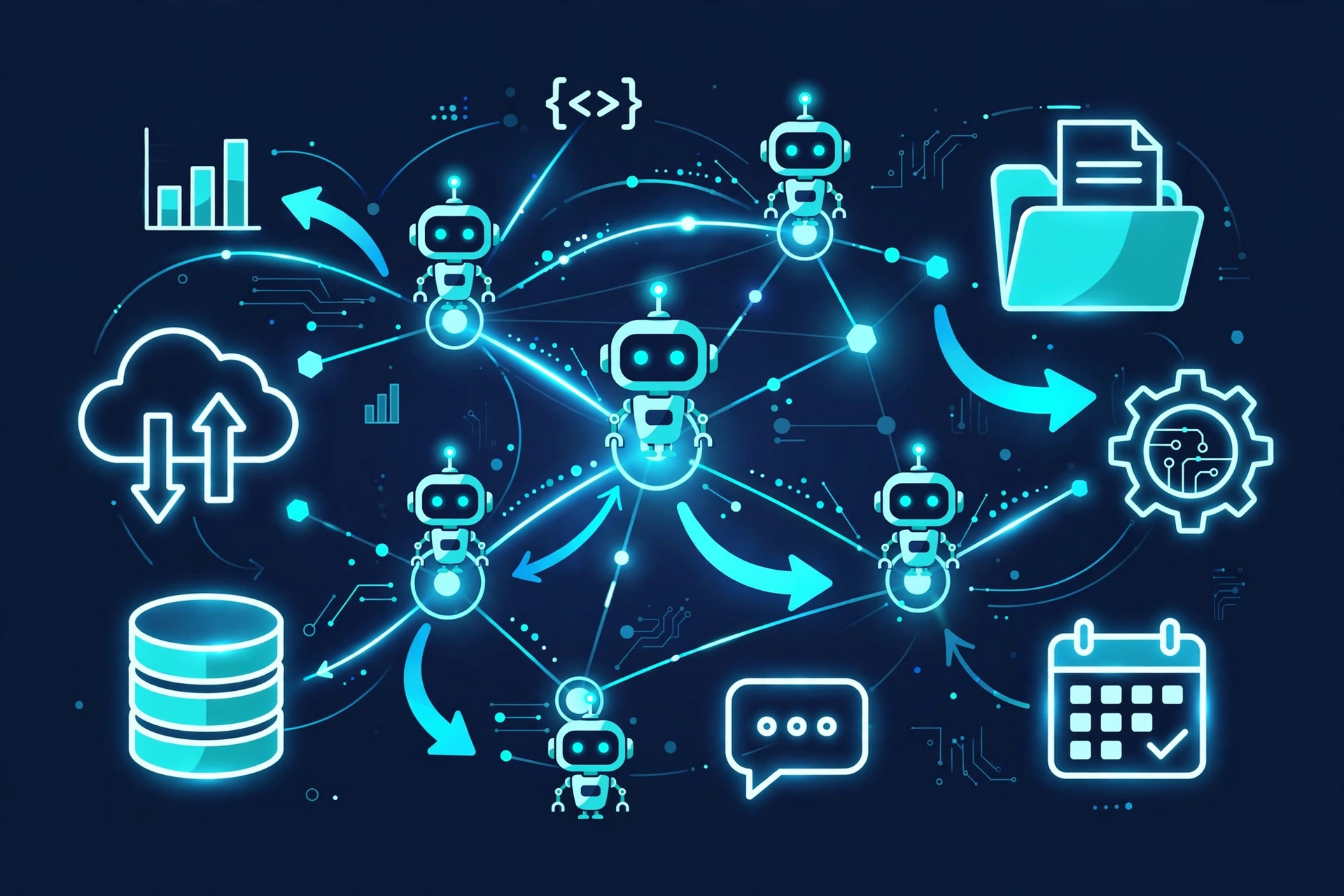
What is agentic AI? It is the question behind one of the biggest technology shifts of 2026. Until recently, AI mostly answered questions: you asked, it replied, and then it stopped. Agentic AI is different — it takes a goal and works toward it on its own, planning steps, using tools, checking results and adjusting until the job is done.
If generative AI was about creating content, agentic AI is about completing work. This guide explains what it means, how it works, how it differs from chatbots, where it is used today, and what risks come with it.
What Is Agentic AI? The Simple Definition
Agentic AI refers to AI systems that can pursue a goal with limited supervision. Instead of waiting for your next prompt, the system breaks a task into steps, chooses the tools it needs, takes real actions, observes what happens, and keeps going until the goal is reached.
The word “agentic” comes from agency — the ability to act. A chatbot produces words; an agentic system sends emails, books meetings, edits files, searches the web and updates databases.
How Agentic AI Works: The Loop
Every agentic AI system runs a loop. It is simple to describe, but powerful in practice.
First, it reasons, planning the steps for a goal such as “research this topic and draft a report.” Next, it acts — searching the web, opening a document, calling an API or running code. Then it observes the result. Finally, it repeats, planning the next step from what it just learned, until the task is done or it needs human help.
Researchers call this the ReAct loop, short for Reasoning plus Acting — now the basic pattern behind almost every AI agent.
The loop needs four ingredients: a language model to think, tools to touch the real world, memory, and permissions that decide what it may do without asking first.
Agentic AI vs Generative AI: What’s the Difference?
Generative AI creates content when asked: you give it a prompt, and it produces text, an image or code. Then it stops. It cannot check its own work in the real world, or take the next step by itself.
Agentic AI uses a generative model as its engine, but adds the loop, the tools, the memory and the permission to act. It does not just write the email — it finds the right contact, sends it, checks for a reply, and follows up if nobody answers.
For businesses, the difference is concrete: a chatbot can draft a customer reply, but an agentic system can read the complaint, check the order, issue the refund and close the ticket — all without a human touching it.
Watch out for “agent washing,” Gartner’s term for rebranding an ordinary chatbot as agentic AI when it cannot really plan or act.
Real Examples of Agentic AI in 2026
Agentic AI is no longer a research idea. It is shipping in real products across many industries.
Coding agents are the most advanced example. Tools such as Claude Code and OpenAI’s Codex take a feature request, explore a codebase, write and test the code, and open a pull request for review. In November 2026, OpenAI announced plans to acquire Pierre Computer Company to improve the Git workflows inside Codex.
Customer service agents now resolve many support tickets end to end: they read the message, check the account, apply the correct policy, and reply, with a human stepping in only for unusual cases.
Finance agents automate research and reporting, pulling data from markets and filings and flagging anything unusual for a human analyst. Research agents can scan hundreds of sources and produce a structured briefing in minutes.
Benefits of Agentic AI
The biggest benefit is time. Agents handle routine, multi-step work around the clock — a task that took a person an hour of clicking between apps can be finished by an agent in minutes. They are also consistent, following the same process every time without forgetting a step.
The other benefit is scale. A small team can use agents to do work that once needed a much larger team — an agent can act like an extra employee for the price of a software subscription.
Risks and Challenges of Agentic AI
Agentic AI also brings new risks, more serious than a wrong answer from a chatbot. When an AI can act, an error is a bad action — a wrong payment, a deleted file, or a message sent to the wrong person.
Security researchers have warned about agent goal hijack, where an attacker tricks an agent into pursuing a different goal from the one its owner set. The OWASP GenAI Security Project published a top 10 list of risks for agentic applications in 2026 to help developers defend against this.
There is also a hype problem. Gartner predicted that more than 40% of agentic AI projects will be abandoned by the end of 2027, often because the task was never suited to an agent or nobody set clear limits. The practical answer is human oversight: keep a human in the loop for important decisions, limit what the agent can access, and log everything it does.
What Agentic AI Means for You
You do not need to be a programmer to benefit from agentic AI. If you run a business, find the repetitive, multi-step tasks that eat your team’s time — those are the first candidates for an agent. If you are an employee, learn to direct agents like a junior colleague: give clear goals, set boundaries, and check the work. Gartner predicts 40% of enterprise applications will include specialised agents by the end of 2026, up from less than 5% in 2025.
Frequently Asked Questions
What is agentic AI in simple words?
AI that works toward a goal on its own: it plans steps, uses tools such as web search or email, checks its results, and keeps going until the task is finished.
What is the difference between agentic AI and generative AI?
Generative AI creates content from a prompt and then stops. Agentic AI uses a generative model inside a loop, so it can plan, take real actions, and complete multi-step tasks on its own.
What is an example of agentic AI?
A coding agent that takes a feature request, writes and tests the code, and opens a pull request. Or a customer service agent that reads a complaint, checks the order, issues a refund and closes the ticket by itself.
Is agentic AI safe?
It can be, if built with limits. Safe systems restrict what the agent can access, require human approval for important actions, and log everything it does.
Will agentic AI replace jobs?
It is more likely to change jobs than erase them. It takes over repetitive, multi-step tasks, pushing human work toward planning, judgement and checking the agent’s output.
What is MCP in agentic AI?
MCP, the Model Context Protocol, is Anthropic’s standard that lets AI agents connect to tools and data sources in a uniform way.