
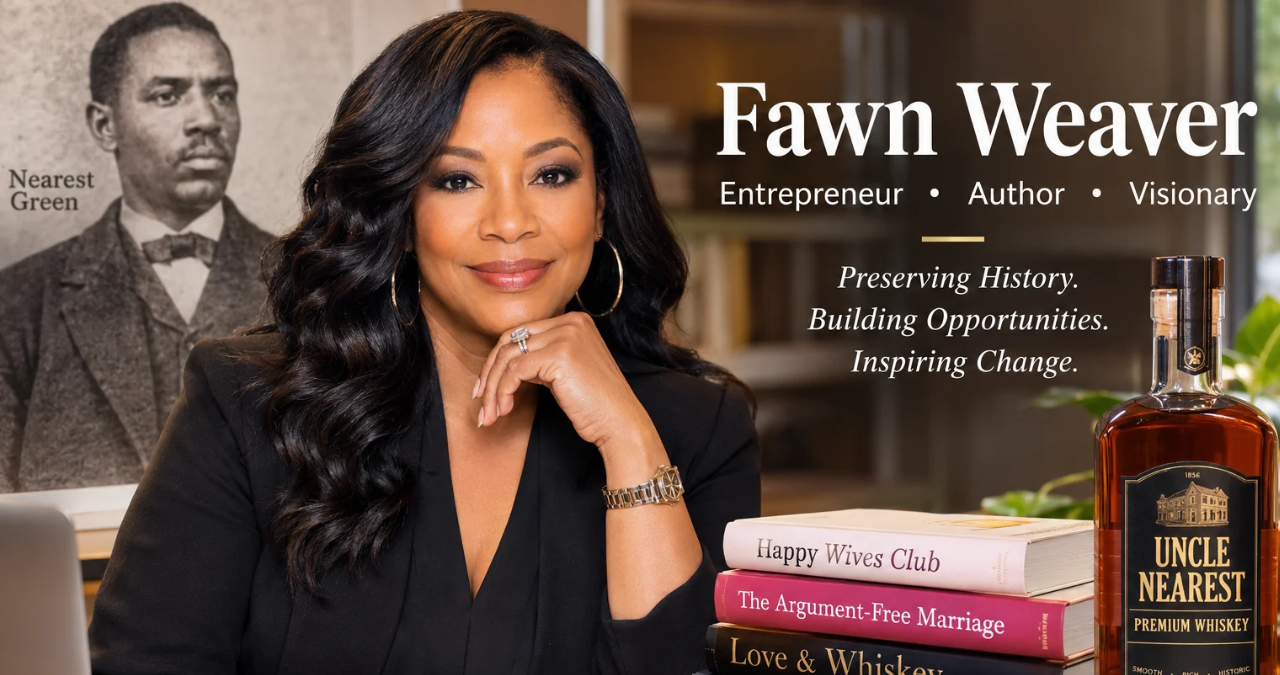
Fawn Weaver is an American entrepreneur, author, speaker, and business leader best known for founding Uncle Nearest Premium Whiskey and bringing greater attention to the story of Nathan “Nearest” Green. Her career combines entrepreneurship, storytelling, publishing, investment, hospitality, and cultural history
What makes her journey especially interesting is that her success was not built around a single career path. Instead, she moved through public relations, hospitality, real estate, writing, investing, and the beverage industry. Along the way, she turned a historical research project into a major business story while also becoming a bestselling author and influential speaker.
This article explores fawn weaver, her early life and career, her books, her connection to Nearest Green, her approach to business, and the broader lessons people can learn from her professional journey.
Fawn Weaver and Her Early Life
Fawn Evette Weaver was born in California and grew up in a family connected to music and ministry. Her father, Frank Wilson, was a Motown songwriter and producer who later became a Christian minister. These early experiences gave Weaver exposure to both creative work and the importance of communication.
Her path was not always smooth. Weaver has spoken publicly about difficult experiences during her teenage years, including periods when she lived away from home and stayed in shelters. Those experiences became part of the larger story she tells about persistence, independence, and building a life through determination.
Rather than allowing difficult circumstances to define her future, Weaver developed an entrepreneurial mindset at a young age. She entered the business world while still young and eventually created a public-relations company called FEW Entertainment. The company gave her early experience in communication, promotion, events, and relationship building.
That foundation would later prove valuable. After all, building a company is not only about having a good product. It also requires knowing how to tell people why the product matters.
Fawn Weaver’s Entrepreneurial Beginning
Weaver founded FEW Entertainment in the mid-1990s. Her early work in public relations helped her understand how stories could influence public attention and shape the way people viewed businesses and individuals.
She later expanded her professional experience into hospitality and management. Her career included work connected to restaurants, hotel groups, and development companies. These roles exposed her to operations, customers, leadership, and the practical side of running organizations.
Her professional journey can be broadly understood through several areas:
- Public relations and communications
- Hospitality and restaurant management
- Real estate and investment
- Publishing and authorship
- Entrepreneurship
- Beverage and spirits
- Philanthropy
- Public speaking
- Corporate leadership
In 2010, Weaver founded Grant Sidney, Inc., a private investment company. Her experience across several industries helped her develop a wider understanding of business rather than relying on expertise in just one field.
That broad background is important when examining fawn weaver because her career doesn’t fit neatly into one box. She’s a storyteller who became an entrepreneur, but she’s also an entrepreneur who understands the power of storytelling.
Fawn Weaver and the Story of Nearest Green
One of the most important chapters in Weaver’s career began when she learned about Nathan “Nearest” Green, an African American distiller whose contributions to Tennessee whiskey history had received far less attention than they deserved.
Weaver became interested in the connection between Green and Jack Daniel. Her research led her to Tennessee, where she investigated Green’s history, family, work, and relationship with whiskey-making. According to published accounts, what began as a research trip eventually became a much larger mission.
The story mattered to Weaver because it wasn’t simply about alcohol or business. It was about historical recognition.
Green had been a formerly enslaved man who became a skilled distiller. Historical accounts describe him as an important influence on Jack Daniel and Tennessee whiskey-making. Weaver believed his contribution deserved to be remembered and presented to a wider audience.
This is where Weaver’s storytelling background became particularly useful. Instead of treating history as something locked away in old documents, she looked for ways to make the story meaningful to modern audiences.
Building Uncle Nearest Premium Whiskey
Weaver founded Uncle Nearest Premium Whiskey around the story and legacy of Nathan “Nearest” Green. The company began operations in the late 2010s and quickly attracted attention in the American spirits market.
The company’s identity was closely connected to Green’s name and legacy. Rather than separating the product from the historical story, Weaver made the history part of the brand itself.
This was an important business decision.
A typical product may compete on price, taste, packaging, or distribution. Uncle Nearest had another powerful element: a story rooted in American history.
The company emphasized:
- Historical storytelling
- Premium whiskey
- Recognition of an overlooked distilling figure
- Black entrepreneurship
- Strong branding
- Community and cultural heritage
- Investment in minority-owned spirits businesses
Published profiles have described Uncle Nearest as a highly successful and award-winning American whiskey brand. Florida A&M University’s 2025 commencement materials described Weaver as founder and CEO and highlighted the company’s extensive awards and growth.
Fawn Weaver’s Business Philosophy
A major part of fawn weaver‘s appeal as a business figure is her willingness to create her own path.
Weaver has described situations in which conventional business advice did not match her goals. In an Inc. article, she explained that she rejected potential investors who required a board seat as a condition of investing because she wanted to preserve control over the direction of the company.
Whether someone agrees with every business decision or not, the lesson is clear: entrepreneurs need to understand their goals before accepting advice.
Good advice isn’t automatically good advice for every situation.
Weaver’s career suggests several useful principles:
| Business principle | What it means |
|---|---|
| Know your purpose | Understand why the business exists |
| Protect the core idea | Don’t lose the original mission while growing |
| Learn continuously | Entering a new industry requires research |
| Use your strengths | Skills from one industry can help in another |
| Tell a strong story | Customers often connect with meaning |
| Build relationships | Long-term success depends on people |
| Stay persistent | Difficult periods don’t have to end the journey |
Her approach also shows why transferable skills matter. Someone doesn’t have to start with decades of experience in a particular industry to become successful there. Curiosity, research, leadership, and determination can help bridge the gap.
Fawn Weaver as an Author
Long before becoming widely known for Uncle Nearest, Weaver had already established herself as a writer and relationship-focused entrepreneur.
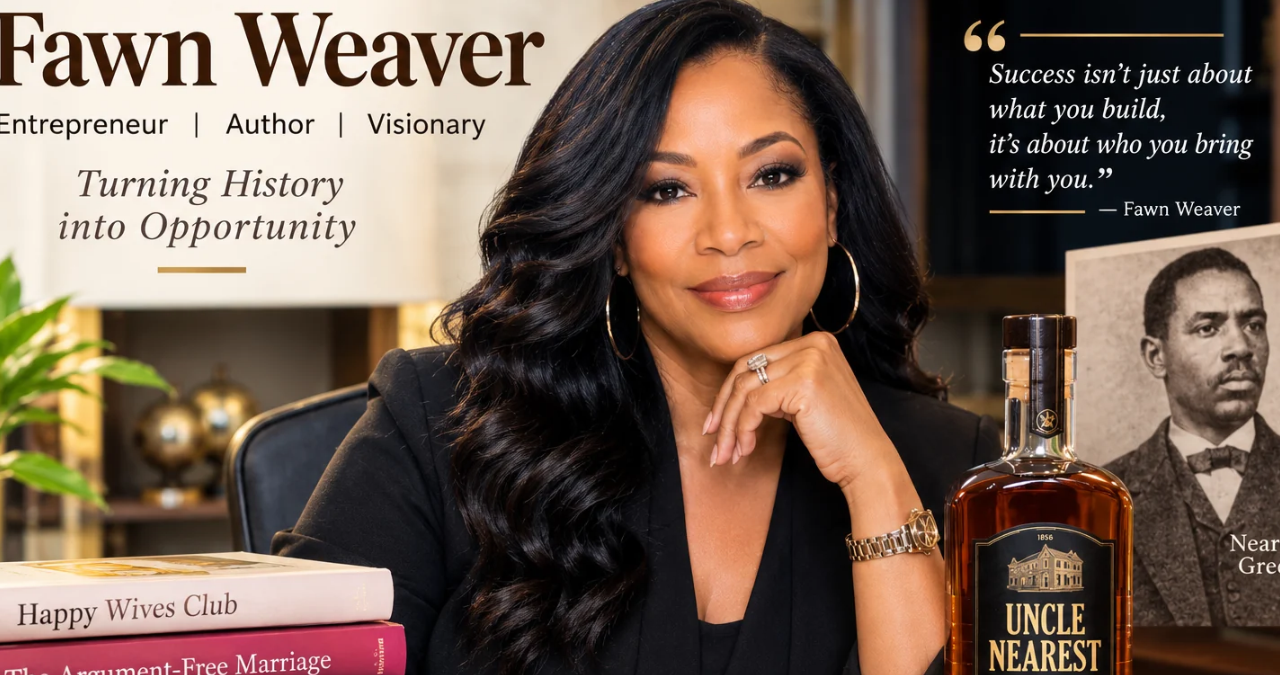
Her first major book was Happy Wives Club: One Woman’s Worldwide Search for the Secrets of a Great Marriage. The book grew out of her interest in successful marriages and the stories of couples around the world. It became a New York Times bestseller.
She later published The Argument-Free Marriage: 28 Days to Creating the Marriage You’ve Always Wanted with the Spouse You Already Have. The book focused on communication and relationship habits.
Her writing career demonstrates another side of her professional identity. She wasn’t simply interested in business numbers. She was also interested in human experiences, relationships, and stories.
That ability to explore personal stories later became highly relevant to her research into Nearest Green.
Love & Whiskey and Historical Storytelling
Weaver’s book Love & Whiskey brought together years of research surrounding Nathan “Nearest” Green, Jack Daniel, their families, and the history of Tennessee whiskey.
According to published material, the project involved extensive research by historians and researchers. The book explores both the historical figures and Weaver’s own journey as she discovered and investigated the story.
This is an important part of understanding fawn weaver because it shows how her different careers connect.
Her work as an author helped her become a better storyteller.
Her experience as an entrepreneur helped her understand branding.
Her research into history helped her identify a forgotten narrative.
Her business experience helped her turn that narrative into an organization.
In other words, her career paths weren’t completely separate. They supported one another.
Fawn Weaver’s Approach to Leadership
Leadership is another important part of Weaver’s professional story.
Her career demonstrates a leadership style based heavily on vision, independence, communication, and persistence. She has often emphasized the importance of continuing forward even when obstacles appear.
Her University of Alabama alumni profile highlighted her view that challenges are part of the journey rather than proof that a person should stop.
That’s a valuable lesson for young entrepreneurs.
Nobody gets a completely smooth road.
A business may face competition. A writer may receive rejection. An investor may say no. A new project may take longer than expected. A leader may make mistakes.
The key is to learn from those experiences rather than allowing them to end the journey.
Weaver’s professional history also shows the importance of developing multiple skills. Communication, management, research, networking, financial thinking, and storytelling can all strengthen leadership.
Fawn Weaver and Education
Although Weaver had already built a substantial professional career, she later returned to formal education.
She completed a bachelor’s degree through the University of Alabama after an earlier attempt at higher education had been interrupted. The university’s alumni publication reported that she graduated in 2023 through its New College LifeTrack program.
She also completed a Corporate Director Certificate from Harvard Business School. The HistoryMakers lists both educational achievements in its biography of Weaver.
Her decision to continue learning later in life offers a useful reminder: education doesn’t have to end when someone begins working.
For professionals, learning can happen through:
- Formal degrees
- Professional certificates
- Books
- Mentors
- Industry research
- Practical experience
- Conferences
- Conversations
- Personal projects
That’s especially relevant today because industries change quickly. A person who keeps learning is often better prepared to adapt.
Fawn Weaver and Investment
Investment has been another significant part of Weaver’s professional career.
Through Grant Sidney, Inc., she developed experience with investments and business ownership. She also became involved in supporting businesses in the spirits industry.
In 2021, Weaver launched the Uncle Nearest Venture Fund, designed to invest in minority-owned spirits businesses. Published profiles reported that the fund had a substantial capital commitment and supported emerging brands.
This approach extends beyond building one company.
Instead of asking only, “How can I grow my business?” an investor can also ask, “How can I help other businesses grow?”
That broader mindset can create opportunities throughout an industry.
Fawn Weaver and the Nearest Green Foundation
Weaver’s interest in history also led to philanthropic work connected to Nearest Green’s legacy.
She founded the Nearest Green Foundation, which focuses on preserving Green’s legacy and supporting educational opportunities connected to his story. Her involvement in historical preservation demonstrates that her interest in Green was not limited to creating a commercial brand.
This distinction matters.
A business can use a historical story as part of marketing, but preserving history requires deeper work. It involves research, education, documentation, and efforts to ensure that future generations can understand what came before them.
The foundation therefore represents another part of the larger legacy associated with Weaver’s work.
Fawn Weaver’s Role in Representation and Entrepreneurship
Weaver has also received recognition for breaking barriers in industries where Black women have historically been underrepresented.
The HistoryMakers describes her as the first African American woman to lead a major spirit brand through her work with Uncle Nearest. Florida A&M University’s commencement materials similarly emphasize her position as one of a small number of Black women to have founded and led a billion-dollar company in U.S. history
Representation matters because visibility can influence who believes entrepreneurship is possible.
When people see someone from an underrepresented background leading a major organization, it can challenge assumptions about who belongs in executive positions.
Of course, representation alone isn’t enough. Successful organizations still require strong products, effective operations, talented teams, sound strategy, and responsible leadership.
But representation can open doors—and sometimes, that’s where change begins.
Major Career Areas of Fawn Weaver
The following table gives a simple overview of the major areas associated with Weaver’s professional journey:
| Career area | Contribution |
|---|---|
| Public relations | Developed communication and promotional skills |
| Hospitality | Gained operational and customer-service experience |
| Real estate | Built experience in property and investment |
| Writing | Published bestselling books |
| Entrepreneurship | Founded and developed multiple ventures |
| Spirits | Built Uncle Nearest around an important historical story |
| Investment | Supported businesses and entrepreneurs |
| Philanthropy | Worked to preserve Nearest Green’s legacy |
| Public speaking | Shared business and leadership lessons |
| Corporate leadership | Participated in boards and executive work |
The table shows why a single job title doesn’t fully describe fawn weaver.
Her career has developed across many connected fields.
Awards and Recognition
Weaver has received significant recognition during her career.
Her honors and professional recognition have included appearances on lists and programs focused on entrepreneurship, business leadership, and cultural influence. The HistoryMakers records recognition from Time, Food & Wine, the Bartenders’ Spirits Awards, Forbes, and the Veterans of Foreign Wars.
Her work has also attracted attention from major business and media organizations. Inc., Forbes, Goldman Sachs, and other publications have featured her story or interviewed her about entrepreneurship and Uncle Nearest.
Recognition, however, should be viewed as one part of a career rather than the entire measure of success.
Awards can highlight achievements, but lasting influence comes from what a person builds, teaches, preserves, and inspires.
Lessons Entrepreneurs Can Learn From Fawn Weaver
There are several practical lessons people can take from Weaver’s professional journey.
Start With a Meaningful Idea
A business can become stronger when its purpose is easy to understand.
Uncle Nearest wasn’t presented simply as another whiskey. Its identity was connected to a historical person whose contribution had been overlooked.
Use Existing Skills in New Industries
Weaver entered the spirits business without decades of experience in distilling.
However, she already had skills in storytelling, marketing, business, and relationships. Those abilities could be transferred to a new industry.
Keep Learning
Her return to university and completion of corporate education show that professional development can happen at any stage of life.
Don’t Ignore Your Story
People often remember stories better than statistics.
For businesses, a genuine story can create emotional connections with customers and employees.
Build for the Long Term
Quick success can attract attention, but building something durable requires systems, people, research, and responsible decisions.
Turn Challenges Into Lessons
Weaver’s public career has included difficult moments as well as major achievements. Her broader story demonstrates that entrepreneurship is rarely a straight line.
Why Fawn Weaver’s Story Matters Today
The importance of fawn weaver extends beyond one company or one industry.
Her career illustrates how entrepreneurship can intersect with history, culture, publishing, investment, and education.
It also raises an important question: How many important stories remain hidden because nobody has taken the time to investigate them?
Weaver’s work around Nearest Green shows what can happen when research meets determination. A forgotten or overlooked historical figure can become the center of a much larger conversation.
At the same time, her journey reminds readers that business success isn’t produced by a single ingredient. It often comes from combining different abilities over many years.
A person might begin as a writer, become an entrepreneur, learn about investment, and later become a business leader. Careers don’t always follow a straight line—and that’s perfectly fine.
Frequently Asked Questions About Fawn Weaver
Who is Fawn Weaver?
Fawn Weaver is an American entrepreneur, author, investor, and speaker. She became widely known for founding Uncle Nearest Premium Whiskey and researching the legacy of Nathan “Nearest” Green.
What is Fawn Weaver best known for?
She is best known for founding Uncle Nearest Premium Whiskey and bringing broader attention to the historical contributions of Nathan “Nearest” Green, an African American distiller associated with the development of Tennessee whiskey.
Is Fawn Weaver an author?
Yes. Weaver is a bestselling author. Her books include Happy Wives Club, The Argument-Free Marriage, and Love & Whiskey.
What is Love & Whiskey about?
Love & Whiskey explores the history surrounding Nearest Green, Jack Daniel, their families, and Weaver’s own research journey into the story.
What business did Fawn Weaver create?
Weaver founded Uncle Nearest Premium Whiskey, a brand built around the legacy of Nathan “Nearest” Green.
What can entrepreneurs learn from Fawn Weaver?
Entrepreneurs can learn the value of persistence, storytelling, research, continuous education, relationship building, and using existing skills when entering a new industry.
Final Thoughts on Fawn Weaver
The story of fawn weaver is ultimately a story about combining purpose with persistence. From public relations and hospitality to publishing, investment, entrepreneurship, and historical research, Weaver has built a career across several fields. Her work surrounding Nearest Green helped bring an overlooked chapter of American whiskey history into a much wider public conversation.
Her journey also offers a practical lesson for readers: a career doesn’t have to follow one straight road. Skills can travel from one industry to another, education can continue later in life, and a powerful story can become the foundation for meaningful work. Whether someone is interested in entrepreneurship, writing, leadership, history, or investing, fawn weaver provides a compelling example of how curiosity, determination, and a clear sense of purpose can shape an extraordinary professional journey.
You may also read
blog blueflamepublishing: A Complete Guide to Understanding Its Purpose, Content, and Value